
我来分享python 2.7实现智能对话的详细操作方法 我来分享一个钓黄尾的配方吧
相信很多朋友都遇到过以下问题,就是python 2.7实现智能对话的详细操作方法。针对这个问题,今天昊普教程小编就搜集了网上的相关信息,给大家做个python 2.7实现智能对话的详细操作方法的解答。希望看完这个教程之后能够解决大家python 2.7实现智能对话的详细操作方法的相关问题。
今天小编就带大家来共同学习python 2.7实现智能对话的详细操作方法,希望可以帮助到有需要的小伙伴哦。
python 2.7实现智能对话的详细操作方法

1.下载python运行环境,这里是使用的2.7,可网络搜索python2.7下载安装
2.python 代码
from aip import AipSpeech
import urllib
import json
import requests
import mp3play
import pyaudio
import wave
import time
APP_ID = \\\'\\\'
API_KEY = \\\'\\\'
SECRET_KEY = \\\'\\\'
aipSpeech = AipSpeech(APP_ID, API_KEY, SECRET_KEY)
key = \\\'\\\'
api = \\\'http://www.tuling123.com/openapi/api?key=\\\' + key + \\\'&info=\\\'
url = \\\"http://www.tuling123.com/openapi/api\\\"
user_id = \\\'tosobright\\\'
def get_file_content(filePath):
with open(filePath, \\\'rb\\\') as fp:
return fp.read()
def getHtml(url):
page = urllib.urlopen(url)
html = page.read()
return html
def getHtml2(data):
body = {\\\'key\\\': key, \\\'info\\\': data.encode(\\\'utf8\\\'), \\\'userid\\\': user_id}
r = requests.post(url, data=body)
return r.text
while 1:
print(\\\"------Start-------\\\")
p = pyaudio.PyAudio()
RECORD_SECONDS = 5
stream =
p.open(format=8,channels=1,rate=16000,input=True,frames_per_buffer=1024)
print(\\\"* recording\\\")
frames = []
for i in range(0, int(16000 / 1024 * RECORD_SECONDS)):
data = stream.read(1024)
frames.append(data)
print(\\\"* done recording\\\")
stream.stop_stream()
stream.close()
p.terminate()
wf = wave.open(\\\"record.pcm\\\", \\\'wb\\\')
wf.setnchannels(1)
wf.setsampwidth(p.get_sample_size(8))
wf.setframerate(16000)
wf.writeframes(b\\\'\\\'.join(frames ))
wf.close()
print(\\\'* Get Data From Baidu\\\')
res = aipSpeech.asr(get_file_content(\\\'record.pcm\\\'), \\\'pcm\\\', 16000, {
\\\'lan\\\': \\\'zh\\\',
})
print res
print res.get(\\\'result\\\')[0].encode(\\\'cp936\\\')
print(\\\'* Get Data From Tuling\\\')
#request = api + res.get(\\\'result\\\')[0].encode(\\\'cp936\\\')
#print request
#response = getHtml(request)
response = getHtml2(res.get(\\\'result\\\')[0])
dic_json = json.loads(response)
print dic_json[\\\'text\\\']
print(\\\'* Get mp3 From Baidu\\\')
result = aipSpeech.synthesis(dic_json[\\\'text\\\'], \\\'zh\\\', 1, {
\\\'vol\\\': 5,
})
if not isinstance(result, dict):
with open(\\\'au.mp3\\\', \\\'wb\\\') as f:
f.write(result)
print(\\\'* Play mp3\\\')
mp3 = mp3play.load(\\\'au.mp3\\\')
mp3.play()
time.sleep(min(30, mp3.seconds()))
mp3.close()
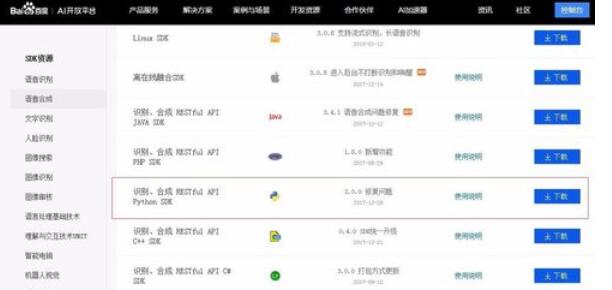
3.注册百度账号,并进入百度AI开放平台,下载sdk,并获取到你个人的
APP_ID = \\\'\\\'
API_KEY = \\\'\\\'
SECRET_KEY = \\\'\\\'
4.注册灵图账号,并获取灵图key,将key值填入代码
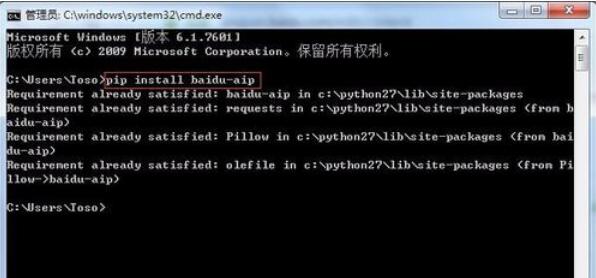
5.安装python的依赖库pip install baidu-aip
pip install requests
pip install mp3play
pip install pyaudio
6.将第2步的代码保存成ai.py文件,并使用python IDE打开,运行即可.
以上就是python 2.7实现智能对话的详细操作方法,希望学习后对你有所帮助。